
The term “Open Gate” has become a central pillar of modern camera marketing, often framed as the ultimate liberation for the digital filmmaker. In the constant dialogue between the gear we use and the stories we tell, it is being hailed as the ultimate safety net—a way to future-proof our work against the ever-shifting demands of social media aspect ratios.
But as someone who has navigated both the rigid deadlines of journalism and the fluid creativity of freelance videography, I’ve learned that “freedom” in tech always comes with a price tag. Let’s peel back the marketing layers and look at what Open Gate actually offers the working creator.
Tearing Down the Tape: What is “Open Gate”?
To understand the function of Open Gate, one must first understand the “gate” itself. In the days of physical film, the gate was the rectangular opening in the camera through which light hit the silver halide. In our digital age, most sensors are shaped in a 3:2 or 4:3 ratio, much like a traditional photograph.
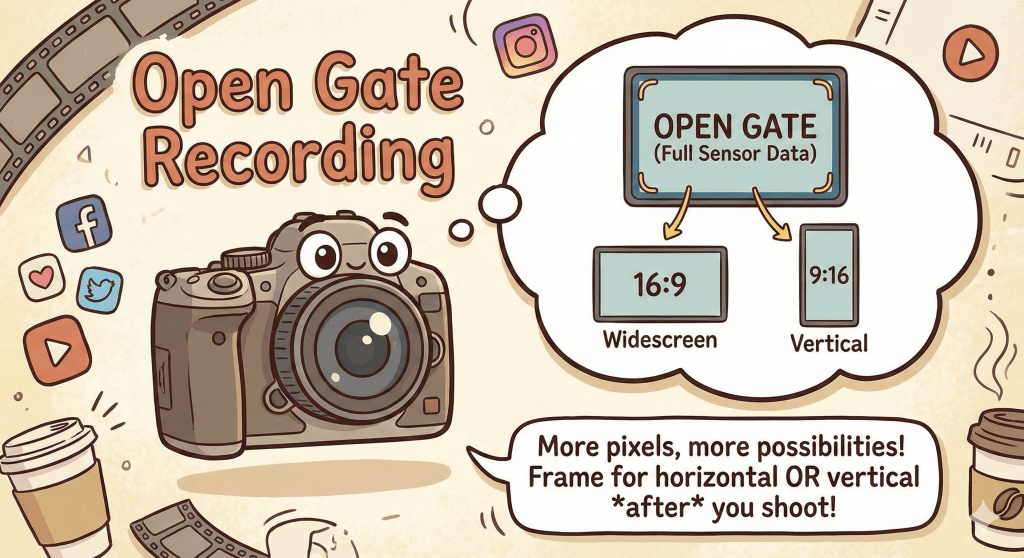
However, for decades, we’ve been conditioned to think in widescreen (16:9). To achieve this, digital cameras simply “mask” or ignore the top and bottom of the sensor. Open Gate recording is the act of removing that mask. It tells the camera to capture every single pixel the sensor can see. It is, essentially, the camera saying: “I will give you everything I have; you decide what to do with it later.”
The “One Take” Hope for a Multi-Platform World
The hope surrounding this feature is rooted in the Multi-Platform Era. We no longer live in a world of a single delivery format. A modern videographer is often tasked with creating a horizontal masterpiece for YouTube while simultaneously providing vertical “shorts” for Instagram or TikTok.
Without Open Gate, extracting a vertical 9:16 frame from a horizontal 16:9 file is a desperate act of compromise; you lose nearly 70% of your resolution, resulting in a soft, cramped image. Open Gate changes the math. By capturing the full height of the sensor, you gain the vertical “breathing room” necessary to output high-quality files for every platform from a single take. For the anamorphic shooters among us, it’s even more vital, allowing the lens to utilize the full sensor height to create that signature cinematic stretch.
Debunking the Data Myth: The Efficient Gate
The historical argument against Open Gate has always been the “Data Tax.” Skeptics—rightly so—pointed out that more pixels usually meant massive bitrates, crumbling hard drives, and computers that sounded like they were preparing for takeoff.
However, the conversation is changing. We are seeing a move away from “unoptimized bulk” toward “efficient flexibility.” Panasonic’s MP4 Lite codec is a prime example. It allows creators to capture the full sensor area at 4K or 6K, but it compresses the data so intelligently that the file sizes remain manageable for mobile editing and fast transfers. It bridges the gap between the high-end cinema world and the fast-paced freelance market, proving that you can have the full frame without the heavy burden of traditional cinema workflows.
The Cost of Indecision: Who Isn’t It For?
Despite the technical benefits, we must ask: where does this feature fail us?
For the Deliberate Artist, Open Gate can feel like an invitation to laziness. There is a profound discipline in the “fixed frame”—the act of deciding exactly what stays in and what is left out at the moment of capture. When we record everything “just in case,” we risk losing the intentionality that defines great cinematography.
In my journalism days, clarity and speed were the primary goals. If I were still in the field chasing a 6:00 PM broadcast, I wouldn’t want the extra metadata or the cognitive load of re-framing a shot in post-production. I would want to “get it right in camera” and ship it. For the high-speed professional, the extra flexibility of Open Gate can sometimes just be extra noise in an already crowded workflow.
Ultimately, Open Gate represents a shift in how we view the frame. It reflects a world where the “window” is no longer a static box, but a fluid space. It is a powerful asset for the hybrid creator, offering a level of flexibility that was unthinkable a decade ago—especially now that codecs like MP4 Lite have made the data penalty almost invisible.
But as we embrace this openness, we must be careful not to let it replace our creative instincts. The best stories aren’t told by the pixels we save “just in case,” but by the choices we make with the pixels we choose to show. The gate may be open, but the vision must still be focused.

Plaats een reactie