
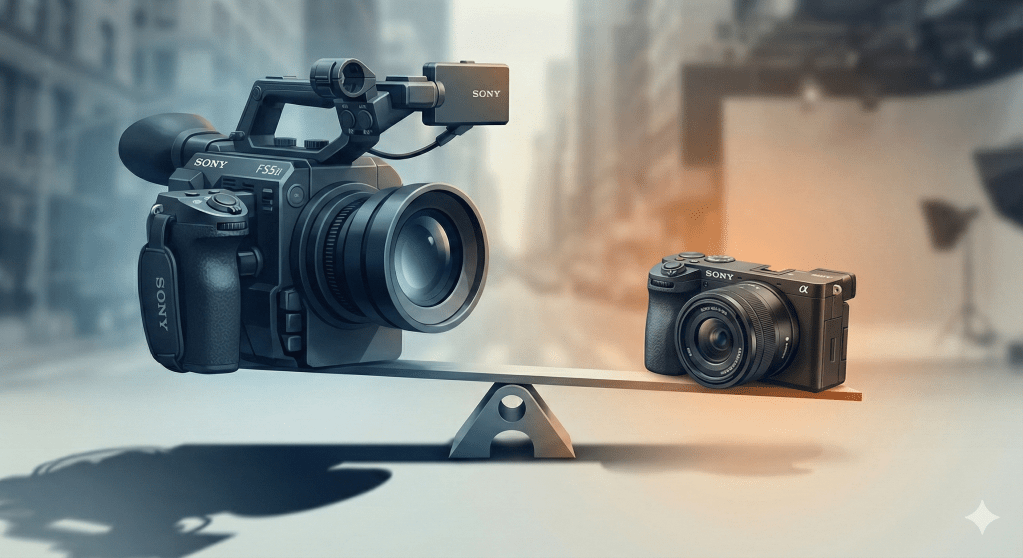
In the professional videography industry, there is an unspoken pressure to move toward dedicated cinema cameras. These modular boxes, with their internal ND filters, professional XLR inputs, and integrated cooling fans, have become the standard for anyone wanting to be taken seriously as a professional. After years of navigating the transition from high-pressure journalism to freelance production, I have felt that pull. The desire to own a tool that checks every technical box is understandable, but it is in the field where these choices are truly tested and where the nuance of gear selection becomes a vital part of the creative process.
The Technical Foundation of the Cinema Box
The technical arguments for a cinema body like the Sony FX series or a rigged-out Canon C-line are based on reliability and precision. Internal ND filters, for instance, are far more than a convenience. They allow for a level of exposure control that remains consistent across different lighting conditions without the optical compromises or color shifts often introduced by external variable filters. When you are on a controlled set or conducting a long-form interview for a client, these features reduce the technical friction between your vision and the final image. They provide a level of thermal confidence that allows the creator to focus entirely on the subject without the nagging fear of hardware failure or overheating during a critical take.
The Complexity of Rigging and Logistical Load
However, the reality of working as a solo operator or in a documentary capacity often reveals a different perspective. When a camera requires a cage, a V-mount battery, an external monitor, and a complex web of cables just to become functional, the gear begins to demand more attention than the story itself. In my experience, especially coming from a background where speed and clarity were the primary metrics, this complexity can become a logistical cage. Every minute spent troubleshooting a loose HDMI connection or re-balancing a heavy cinema rig on a gimbal is a minute lost to the actual observation of the scene. The cognitive load of managing a machine often competes with the mental energy required to frame a shot or listen to the emotion of a subject.
The Observer Effect and the Psychological Barrier
One of the most significant, yet frequently overlooked, factors is the psychological impact of the gear on the people in front of the lens. I often refer to this as the Observer Effect. A fully rigged cinema camera is a loud statement. It announces a Production with a capital P. In many professional scenarios, especially those requiring authenticity or discretion, this presence can be a distinct liability. It changes the atmosphere of the room. People who were once acting naturally or speaking candidly often become guarded or, conversely, start performing for the lens. The barrier between the tool and the subject grows thicker, and the raw, unscripted truth of a moment becomes harder to capture.
The Strategic Utility of the Compact Tool
This is where the compact tool, such as the Sony a6700, proves its professional worth. While it lacks the cinema label and the internal ND filters of its larger siblings, its form factor allows for a level of intimacy that a large rig cannot match. When I use a smaller camera, the psychological barrier drops. I am no longer a production crew; I am a person with a lens. This allows for a much more nuanced dialogue with the subject. I can move faster, react to changing light instantly, and capture the subtle human nuances that a cinema rig might inadvertently stifle simply by being too present. The a6700 might be seen as an amateur tool by some, but in the hands of a professional who values discretion, it is a high-precision instrument for storytelling.
The Intersection of Journalism and Freelance Artistry
My career has been an oscillation between the fast-paced world of reporting and the more contemplative world of freelance production. Journalism taught me that the message is the heartbeat. If the gear prevents you from capturing the message, the gear is a failure, regardless of its price tag. This background influences how I look at a frame today. I often find that the best work happens when the camera stays out of its own way. While I appreciate the character and build quality of Blackmagic, Panasonic, or Sigma systems, I have learned that the best camera is the one that facilitates a dialogue between the maker and the tool without becoming a distraction.
Redefining Professionalism Beyond the Gear
True professionalism is not defined by the size or the price of the camera. It is defined by the ability to recognize which tool serves the specific dialogue of the moment. If I am on a high-end commercial set where the client expects a certain aesthetic and the environment is entirely controlled, the cinema body is the correct choice. It provides the tactile control and stability required for that specific, rigid workflow. It allows for a standardized approach where every button is exactly where it needs to be for a long day of production.
Finding the Balance in Your Creative Process
But when the project demands agility and a connection to the subject that feels unforced, the trade-off of a cinema body becomes too heavy to justify. Managing external ND filters and being mindful of battery life on a smaller body is a small price to pay for the ability to remain invisible and responsive. The goal of any creator should be to find the tool that allows them to tell the story without getting in the middle of it. We become better videographers when we stop chasing technical checkboxes and start analyzing the efficiency and emotion of our actual workflow.
The Continuing Conversation of the Lens
Ultimately, the choice of a camera system is a personal decision that must be weighed against the specific needs of the job and the creative goals of the maker. The dialogue between the maker and the tool should be one of ease, not struggle. Sometimes, the most professional decision you can make is to leave the cinema box in the studio and pick up a tool that allows you to be an observer rather than a technician. By understanding the limitations of our gear, we can better understand our own creative potential.
What is your personal criteria for selecting gear when the requirements of the story clash with the expectations of a professional setup? Have you found that your largest rig has ever cost you a shot that a smaller, more nimble camera would have caught? I would be interested in hearing your observations on how form factor influences your creative process. Let’s keep the conversation going.

Plaats een reactie