
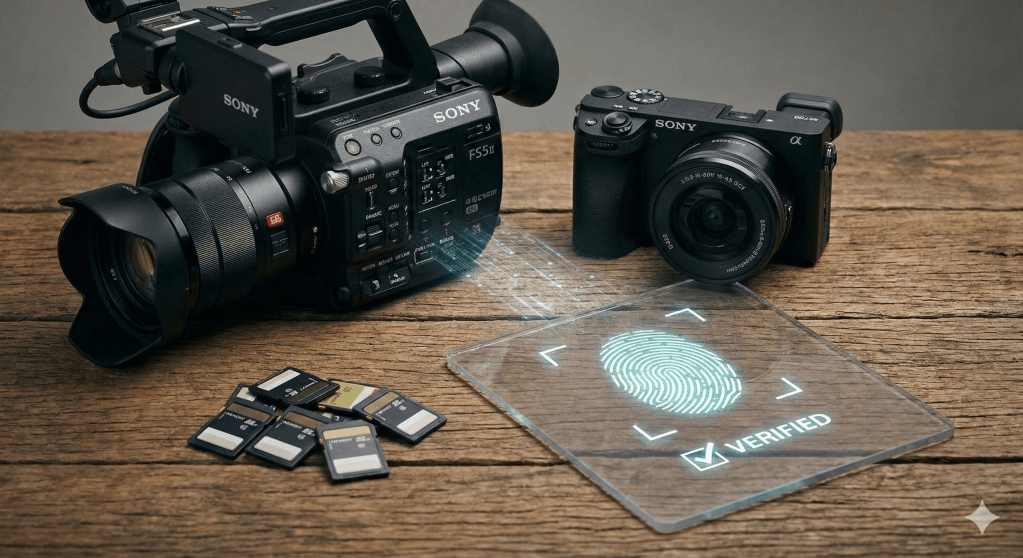
The last decade of camera development has been defined by an arms race of quantifiable specifications. We have seen resolution climb rapidly from 4K to 8K and beyond, and we have watched dynamic range expand to points that often exceed the practical requirements of the human eye. The spec sheet has become the primary battleground for manufacturers, and on paper, the tools we have today are miracles of engineering. However, as I survey the current landscape of cinematography—ranging from high-stakes news items to independent freelance production—I find myself questioning if this pursuit of technical perfection is missing the most critical challenge of our era: the ability to prove that what we captured actually happened.
The Erosion of Visual Trust in a Digital Age
We have reached a point where the “truth” of a moving image is no longer a given. With the rise of generative AI and increasingly sophisticated manipulation tools, the boundary between a captured moment and a synthesized one has blurred. In my journalism background, the goal was always truth, but that truth now faces an existential threat. It is no longer enough for an image to look real; it must be verifiable. This is why the next real battleground for cinema bodies isn’t 12K resolution or higher frame rates—it is the integration of hardware-level authentication and content credentials.
The Documentary Requirement for Provenance
For the documentary filmmaker, authenticity is the only currency that matters. If the audience begins to doubt the origin of a frame, the emotional impact of the story evaporates. Next-gen cinema bodies must move beyond being simple data-capture devices and become secure vaults for visual history. We are seeing the beginning of this with standards like C2PA and Content Credentials, which aim to bake metadata directly into the file at the moment of capture. This “digital fingerprint” records the who, what, and where of a clip, creating a chain of custody from the sensor to the screen. In a documentary context, this isn’t a luxury; it is a defensive necessity.
Authentication as a Creative Dialogue
When I talk about the dialogue between the maker and the tool, I’m usually referring to ergonomics or color science. But in today’s landscape, that dialogue has to include trust. If my camera can cryptographically sign a piece of footage the moment I hit the record button, it changes the way I approach a story. I can focus on the raw, unscripted nuances of a scene, knowing that the integrity of that capture is protected by the hardware itself. This shift allows the filmmaker to stand behind their work with a level of authority that a standard, unsigned file simply cannot provide. It moves the conversation from “did this happen?” to “why does this matter?”
Beyond the Clinical Sensor
While many manufacturers are still obsessed with creating the “cleanest” possible sensor, the industry is actually hungry for character and honesty. We have reached a point of diminishing returns on clinical perfection. If a sensor is too perfect, it starts to look artificial, which only feeds the public’s growing skepticism of digital media. The next generation of professional tools needs to find a way to balance high-end fidelity with a look that feels grounded in reality. When you pair an organic, textured image with a secure authentication check, you create a piece of media that feels both human and irrefutable.
The Logistical Burden of Proof
Integrating these authentication checks into a fast-paced workflow is the next great engineering hurdle. As someone who has spent years in the field, I know that any feature that adds friction to the process will eventually be ignored. These verification tools cannot be buried in the same complex menus that currently plague many cinema boxes. They must be seamless and automatic. The goal is for the camera to act as a silent witness—one that provides a secure record of the event without requiring the operator to act as a forensic technician. The a6700 or a rigged-out fs5ii are valuable because they stay out of the way; authentication must do the same.
Redefining the Professional Standard
True professionalism in the coming years will be measured by more than just the quality of the glass or the depth of the bit-rate. It will be defined by the ethics of the capture. When we stop talking about what our cameras can do and start talking about what we do with them, we have to include the responsibility of maintaining the truth. Manufacturers that ignore the need for content credentials in favor of more marketing-friendly specs are failing to prepare their users for the reality of modern media consumption. We need tools that help us preserve the integrity of the scene just as much as we need tools that help us light it.
The Future of the Cinematic Witness
Ultimately, the choice of a camera system is becoming a choice of which ecosystem you trust to protect your work. The dialogue between the maker, the tool, and the audience is built on the assumption that the image represents a real interaction with the world. By embracing hardware-level authentication, cinema camera design can move toward a future where “cinematic” refers not just to a look, but to a standard of truth. We become better creators when we recognize that our ultimate responsibility is to the story, and in a world of digital shadows, the strongest story is the one that can be proven.
What is your criteria for trusting the footage you see online today, and how much would a “verified” badge influence your perception of a documentary? The conversation about how we prove our work is just beginning, and it is a dialogue that every person behind a lens needs to join. Let’s keep the conversation going.

Plaats een reactie