
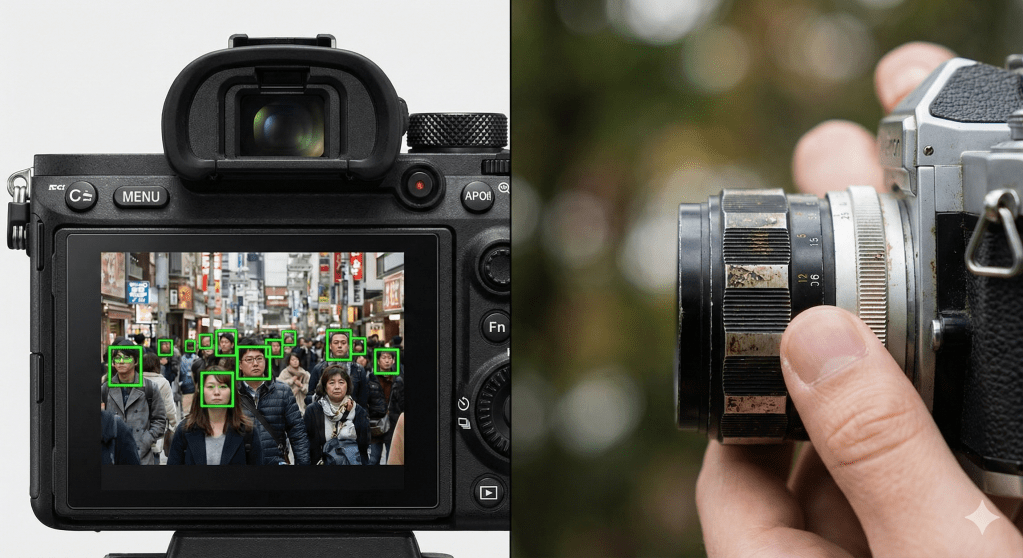
We exist in a golden age of automation. The autofocus systems in modern mirrorless cameras, from the compact Sony a6700 to the specialized cinema bodies like the FS5II, border on sorcery. We have reached a point where the camera can not only identify a human eye at a hundred feet but can lock onto it with a tenacity that human reflexes simply cannot match. For those of us who cut our teeth in the high-pressure environment of journalism, where a missed beat meant a missed story, these advancements are nothing short of miraculous. Yet, despite having access to the most advanced tracking algorithms ever developed, I find myself sometimes reaching for lenses that require me to do the work myself.
The Safety Net of the Algorithm in the Field
The professional argument for modern autofocus is irrefutable in many scenarios. When I am filming a fast-moving news item or covering an event where the subject’s movement is entirely unpredictable, relying on a sophisticated AF system is a matter of professional responsibility. It is a safety net. It allows me to reallocate my mental energy away from the technical anxiety of maintaining sharpness and toward the framing and emotional content of the scene. The ability to trust the gear to handle the math while I handle the story is a profound relief in high-stakes production environments where there are no second takes.
The Emotional Disconnect of Effortless Capture
However, there is a subtle, almost insidious side to this technological perfection. When the camera handles the focus entirely, I sometimes feel a distinct disconnection from the process. I become less of an operator and more of a passive observer, trusting a computer to decide what is important in the frame. While the algorithm is technically proficient, it lacks artistic intent. It seeks contrast and edges; it does not understand narrative weight. There are moments when the camera’s decision to snap focus instantly to a face betrays the slower, more deliberate pacing that the scene actually requires. The machine sees a target; the filmmaker sees a moment.
The Tactile Weight of Human Intention
Turning off the autofocus and gripping the dampened ring of a manual lens is an act of taking back control. It is a physical declaration of intent. Manual focus forces a deceleration. You cannot just point and shoot; you must look, assess, and deliberately decide where the viewer’s eye should rest. This physical engagement with the lens creates a feedback loop that is entirely absent in the electronic disconnect of modern systems. It forces you to breathe with the scene. Whether it is a modern cinema prime or a piece of vintage glass adapted to a new sensor, that tactile connection reminds you that you are making a choice, not just recording data.
Focus as a Dynamic Narrative Device
Focus is not merely a technical requirement for an acceptable image; it is one of our most powerful narrative devices. The speed and timing of a rack focus can change the entire emotional context of a shot. An algorithmic snap-focus often feels clinical and jarring. In contrast, a human hand pulling focus has an organic texture, slight imperfections, and a cadence that mirrors human thought. The slight breathing of older manual glass during a focus pull adds a kinetic energy to the frame that modern, clinically corrected lenses often lack. By outsourcing focus to the camera, we are occasionally outsourcing a crucial element of our storytelling.
Finding the Balance Between Speed and Soul
The debate is not about rejecting technology. It is about understanding when technology serves the vision and when it dilutes it. There are shoots where the speed of modern AF is the only way to get the job done, and as a professional, I would never ignore that utility. But as creators navigating the space between journalism and art, we must recognize that sometimes the most professional choice is the harder one. Choosing to focus manually is choosing to be fully present in the act of creation, accepting the risk of a missed mark for the reward of a deeper, more intentional connection with the image.
The Resistance Against the Perfect Image
There is a growing resistance in the creative world against the “perfect” digital image. We see it in the resurgence of film and the obsession with vintage lenses. People are hungry for something that feels less like a computer-generated rendering and more like a captured memory. Manual focus is part of that resistance. It allows for the “happy accident”—the slight delay in focus that feels like a human eye searching for detail. It adds a layer of authenticity that an algorithm, no matter how advanced, cannot replicate because it is designed to eliminate the very variables that make an image feel alive.
The Continuing Dialogue of the Lens
Ultimately, the goal is to ensure that every element within the frame is there because you decided it should be, not because a processor detected the highest micro-contrast. The choice between autofocus and manual control is really a choice of agency over our own work. In a world increasingly driven by perfect algorithms, the imperfect, human hand on the focus ring is becoming a radical artistic statement. We become better creators when we stop letting the camera make the decisions and start having a real conversation with the light and the subject in front of us.
What is your criteria for handing over control to the camera? Have you ever found that a perfectly sharp autofocus shot lacked the soul of a slightly flawed manual one? I would be interested in hearing how you navigate the balance between technical perfection and creative intent. Let’s keep the conversation going.

Plaats een reactie