
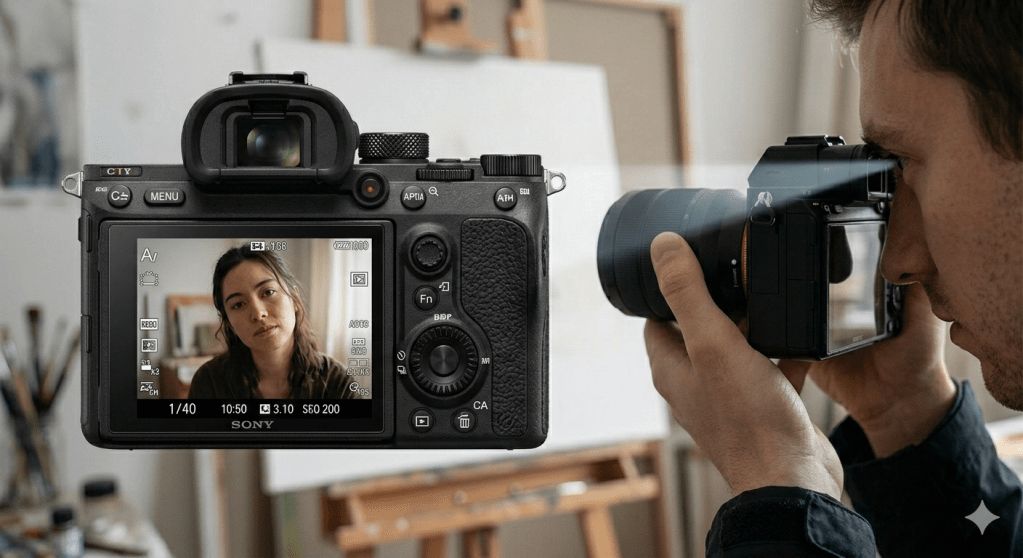
We are living in an era defined by glorious displays. Modern mirrorless systems offer bright, articulated, and responsive rear screens that have fundamentally changed how we frame our world. The screen is the default; it allows for ground-level stabilization and facilitates the “gamer” workflow where the operator can remain slightly detached, checking settings and composition simultaneously. In my experience balancing fast-paced journalism with contemplative freelance production, I have felt the strong gravitational pull of the screen. Yet, on assignments where authenticity and focus are the primary metrics, I frequently find myself pressing the camera against my face. This raises a question that tech specs rarely answer: How essential is the viewfinder?
Sensory Isolation and the State of Flow
The functional definition of a viewfinder has shifted. It is no longer just a framing aid; it is a sensory isolation chamber. When you use the rear screen, you are observing the scene as well as the world around the screen. There is a cognitive load that comes from filtering distractions. When you move the camera to your eye, you create a dedicated pathway for light and emotion. The electronic viewfinder (EVF) on cameras like the a6700 or the dedicated oculars on larger cinema bodies create a profound separation from the environment. This isolation facilitates the state of flow that is necessary for capturing authentic, raw human nuances. It turns the act of observation into a focused meditation, allowing the lens to listen without the intrusion of external chatter.
Functional Necessities in Uncontrollable Light
The technical arguments for the EVF are undeniable in practical scenarios. Uncontrollable light is the nemesis of the perfect screen image. No matter how bright the rear display, a midday sun hitting it directly will introduce technical friction, causing you to struggle to judge exposure, focus, and, most importantly, the subtle dialogue of the subject. A hooded EVF bypasses this challenge entirely, offering a consistent, protected view regardless of the environment. Furthermore, in fast-paced reporting where stability is paramount, pressing the camera body against your brow provides an extra point of contact, offering essential physical bracing that a handheld screen workflow cannot match. The physical connection anchors the tool, reducing micro-jitters and allowing for smoother tracking.
The Psychology of Holding the Camera
Perhaps the most crucial, yet subtle, impact of the viewfinder is psychological. When you hold a camera with an articulated screen out in front of you, you are holding it like a gamer or a technician. You are observing a production. Subjects react to this stance; they are performing for a monitor. In contrast, moving the camera to your eye creates a kinetic dialogue. The camera becomes an extension of the self. This stance signals to the subject that you are not merely capturing a sequence of data points, but that you are deeply present, watching, and reacting to their truth. The Observer Effect that we discussed in previous conversations is mitigated by the perception of personal engagement that only the viewfinder creates.
The Dialogue of Agency and Choice
The debate is not about rejecting screen technology. Modern screens are brilliant, essential tools for specialized framing and ergonomic relief. True professionalism is about understanding which dialogue the moment requires. If I am in a controlled studio or setting up a complex gimbal move, the screen is my primary interface. But when the assignment requires intimacy, speed, and the capture of raw, fleeting truth, the viewfinder transitions from being a technical requirement to an ethical necessity. By defining the essential, we reclaim agency over our work. We decide when technology should disappear, facilitating a direct connection between the intentional eye and the captured light.

Plaats een reactie