
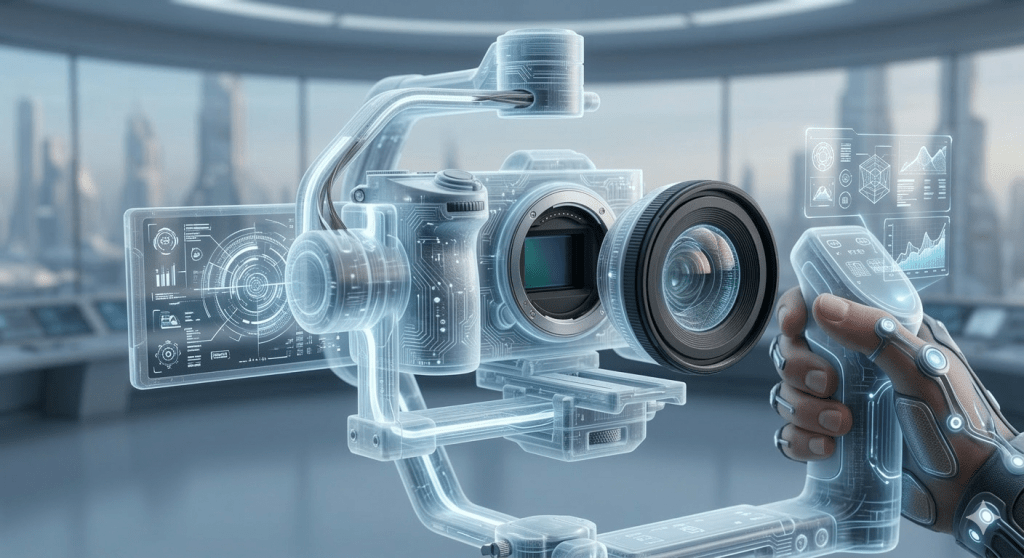
For decades, the camera industry operated under a predictable hierarchy of design. A camera was a box that held a sensor, and everything else (like stabilization, focus, and connectivity) was an accessory to that core. This legacy has given us incredible tools like the Sony FS5II or the a6700, but it is a design philosophy rooted in an era where the operator was expected to manage every physical variable manually. We are now approaching a definitive intersection where the drone logic of companies like DJI is beginning to collide with the traditional mirrorless mount. This isn’t just a new product launch. It is a fundamental re-imagining of what a hybrid camera should be.
The Evolution of the Stabilization Standard
The argument that traditional manufacturers have ignored stabilization is, of course, factually incomplete. In-body image stabilization (IBIS) has become a benchmark feature across the Sony, Canon, and Panasonic lineups. These systems are engineering marvels, using floating sensors and magnetic actuators to compensate for handheld shake. For the photographer or the stationary videographer, IBIS is often the difference between a usable frame and a blurred one. However, IBIS has reached a point of diminishing returns. It is designed to handle micro-jitters and slight movements. When you introduce the kind of kinetic, walking, or tracking motion required in modern documentary work, IBIS alone often fails to deliver the fluid, cinematic stability that an integrated gimbal system provides.
The Legacy of the Mechanical Burden
Even with modern IBIS, professional-grade movement often still carries a heavy mechanical burden. To get truly smooth results while moving through a space, we have historically relied on external gimbals, cages, and complex rigging. This adds layers of technical friction to a shoot. In my background in journalism, every extra piece of gear was a potential point of failure. The traditional titans have refined the sensor and the autofocus to near-perfection, but they have largely left the problem of high-intensity physical stabilization to the third-party market. This has created a workflow where the tool often feels like a collection of disparate parts rather than a cohesive instrument. You spend more time balancing your rig than you do looking at the subject.
The Arrival of the Integrated Eye
Drone specialists approach the camera from a completely different starting point. For a company like DJI, the camera has never been a static object. It has always been a kinetic, stabilized, and highly integrated system. Their experience with the Ronin 4D and the Osmo series has proven that you can bake professional-level 4-axis stabilization and LiDAR focus directly into the form factor. When these companies move into the dedicated mirrorless space, they aren’t just releasing another camera. They are releasing a kinetic eye. This is a tool where the stabilization isn’t an add-on or a floating sensor plate, but a fundamental part of the camera’s structural relationship to the world.
Redefining the Professional Workflow
The threat to the established giants lies in the simplification of the professional workflow. If a solo operator can achieve a perfectly stabilized, high-bitrate cinematic shot with a single body without the need for a separate gimbal or a complex rig, the professional argument for a traditional mirrorless system begins to erode. This is the democratization of high-end production value. We are moving toward a dialogue where the barrier to entry for cinematic movement is being lowered not by cheaper gear, but by smarter, integrated gear. The goal is to reach that state of flow where the technical requirements of a shot disappear, leaving only the intentionality of the frame.
The Battle for the Primary Lens Mount
The real tension will come as these drone-born systems begin to support established lens mounts natively. We are already seeing rumors of L-mount and E-mount integration in these upcoming disruptors. Imagine a body with a native mount that incorporates internal ND systems, wireless transmission, and LiDAR-driven autofocus for manual lenses. This forces a radical reassessment of what we consider a professional camera. Traditional manufacturers would no longer be competing just on image quality. They would be competing against an entire ecosystem of integrated movement and data. It is a transition from the camera as a capture device to the camera as a complete, intelligent production hub.
The Resilience of the Traditional Titan
Of course, the established giants are not without their own defenses. Their advantage remains their deep understanding of color science, weather sealing, and the specific kind of professional reliability that newcomers often struggle to replicate. The traditional titans still own the relationship with the professional who needs a tool that works in a blizzard or a desert without hesitation. However, they can no longer afford to be complacent about the physical ergonomics of their systems. The arrival of the drone-logic camera will force them to innovate in areas they have neglected for years, specifically in how a camera moves and connects in a modern, fast-paced environment.
The Creative Potential of the Integrated Future
Ultimately, this shift is a win for the creator. Whether you choose the traditional reliability of the established giants or the integrated, kinetic logic of the new disruptors, the result is more agency. We are gaining tools that are designed to facilitate the capture of authentic, raw human nuances without the gear getting in the way. As these drone specialists move into the mirrorless space, they are bringing a philosophy of effortless capture that will redefine the standards of the industry. The conversation is no longer just about the sensor. It is about how that sensor interacts with the movement of the world.

Plaats een reactie