
If you’ve spent any time looking at camera advertisements lately, you’d be forgiven for thinking that anything smaller than a Full Frame sensor is a toy. The marketing machine is in overdrive, pushing the narrative that “real” professionals only shoot Full Frame. It’s a compelling story: better low light, shallower depth of field, and that “premium” look.
But as someone who has moved between the high-pressure world of independent journalism and the varied demands of freelance videography, I’ve noticed a curious gap between what the marketing says and what the job actually requires. The truth? APS-C—or its cinematic sibling, Super 35—isn’t just a “budget” alternative. For many of us, it is the superior choice for the work we do every day.
The Super 35 Legacy
It’s ironic that Full Frame is marketed as the “cinematic standard” when, for decades, the literal standard of cinema was Super 35. Countless Oscar-winning films were shot on a sensor size roughly equivalent to the APS-C sensor in a modern mirrorless camera.
When we talk about the “cinematic look,” we are often talking about the field of view and depth of field characteristics of Super 35. In these moments, that slightly deeper plane of focus on an APS-C sensor isn’t a limitation—it’s a safety net that ensures your shot is actually usable.
The “Just Stop Down” Fallacy
A common counter-argument from the Full Frame crowd is: “If the depth of field is too shallow, just stop down your lens to f/4 or f/5.6.” Mathematically, they are right. But practically, this argument falls apart:
• The Weight Tax: Stopping down doesn’t make the lens smaller. You are still lugging around massive Full Frame glass and heavy filters.
• The Low-Light Paradox: If you stop down from f/2.8 to f/4.5 to keep your subject in focus, you’re letting in less light. You end up cranking your ISO, essentially “downgrading” your expensive sensor’s performance to match the APS-C sensor you were trying to avoid.
The Producer Puzzle: Dealing with the “Full Frame Mandate”
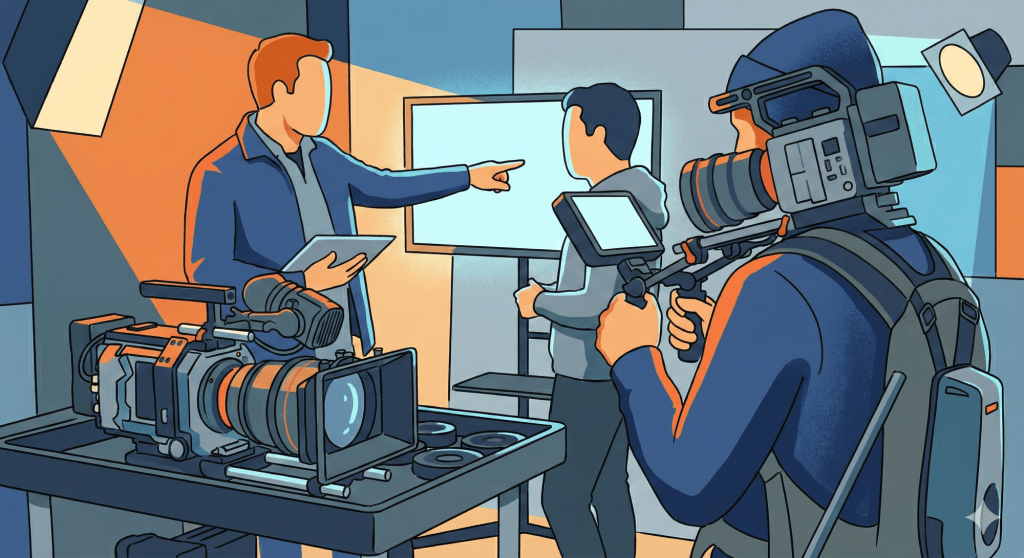
Despite the technical logic, we have to face a very real market reality: The Producer. In many professional circles, “Full Frame” has become a checkbox on a gear list. Producers or clients who have read a few blogs often demand Full Frame because they believe it’s a shortcut to a “high-end” look.
As creators, how do we deal with a demand that might be technically nonsensical for the specific project? Based on industry discussions and forum deep-dives, here is how to navigate the “Full Frame Mandate”:
1. Rebrand the Terminology: Stop saying “APS-C” or “Crop Sensor”—those terms sound like a compromise. Start using “Super 35.” It is the historically accurate term for this sensor size in the film industry. When you tell a producer you are shooting on a “Super 35 Cinema Sensor,” the conversation shifts from “budget” to “Hollywood standard.”
2. Highlight the “A-Cam” Specs: If you’re using a camera like the Sony FX30 or a Fujifilm X-H2S, focus the conversation on the 10-bit 4:2:2 internal recording, dynamic range, and framerates. Most producers care about the final image quality and Netflix-ready specs more than the physical dimensions of the sensor.
3. The “Efficiency” Pitch: If a producer is pushing for Full Frame on a fast-paced documentary or a solo-op corporate shoot, explain the trade-off in terms of agility and budget. “We can go Full Frame, but it will require a larger gimbal, heavier tripods, and more time for focus pulling, which might limit how many setups we can get in a day.” Most producers will choose more shots over a slightly larger sensor every time.
4. Show, Don’t Tell: If the “Full Frame” demand is non-negotiable, show them a side-by-side (if possible) or a portfolio shot on Super 35. Most people cannot tell the difference in a blind test.
Choosing the Right Dialogue
At the end of the day, my experience across Sony, Canon, Blackmagic, Panasonic, and Sigma systems has taught me that suitability beats specs.
As an amateur photographer, I enjoy the challenge of different formats. But as a videographer who has to deliver results, I’ve learned to ignore the “Full Frame FOMO.” The goal of Camera Conversations is to look past the spec sheets. Next time you’re told you need to upgrade to Full Frame to be taken seriously, ask yourself if those extra millimeters of silicon will actually make your story better—or if you just need to change the way you talk about the gear you already own.

Plaats een reactie